
Alchemy of Art Results
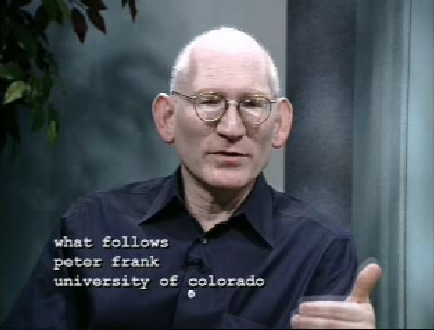
Interview with our Juror - Peter Frank
Lark: What principles or criteria did you use to choose the best artists in this competition?
Peter: "What I am always looking for, while judging art exhibitions - beside the element of surprise, which is the bonus - is art that fulfills its goals technically and spiritually - the realization or communication of vision.
L: Do you have any preference of styles?
P: No. For me it is more important how an artist has managed to express his/ her idea, how interesting and unique is the artist's creative language, how skillfully he/she uses this language, and finally, what depth of experience and sensation his/her art conveys to me.
Technically speaking, it is also important how well art occupies space and time, but it is not just the right combination of colors and lines that the artist may have stumbled upon, but how masterful the artist is in unlocking this right combination within him - or herself. You cannot make what is not within you
L: Can you, please say a few words about our winners and why their artworks attracted your attention? Lets start with Rachael McCampbell.
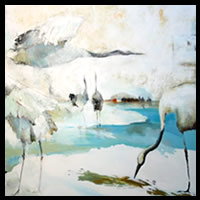
P: For me what is really interesting is what Rachael is going for in her art. Let’s talk for example about her painting “Direction of Cranes". The image of the subject in this work is not presented simply as a picture, but as a recurring motif. Her sense of space is very complex, it doubles back on itself, giving this artwork an element of surrealism. Rachael also has a strong drawing technique - always a plus in representational painting – and interesting clear surface texture.
L: A few words about our second place winner, Rick LaFleur
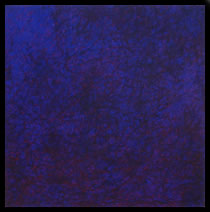
P: Rick is working out of a minimalist aesthetic, but making it far more intricate, far more complex, giving a visual texture to what could be a pure field of color. It's clearly a meditative process, and he is manifesting this meditation.
Colors are very important in Rick’s artworks - the sensation, - the condition of contemplation, equanimity and neutrality. All together, the visual and intellectual complexity of his art produces the impression of mental and spiritual depth.

L: And finally we have two third place winners, Sheila Elias and Lisa Bahouth.
P: Sheila works in photomontage style, much like an old-time Dadaist, to shake us out of our expectations. But she deliberately doesn't make entirely clear what she is making us pay attention to. She doesn't tell us what to think or what to think about. The angelic figure silhouetted against a modern building in her picture “Courage Of An Angel” - gives us some feeling of distress but also many more emotional and narrative possibilities. The image itself is powerful enough to provoke multiple interpretations.
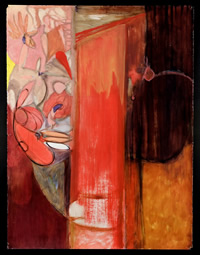
Lisa Bahouth’s abstract-expressionistic art work shows, that she has talent for line, movement, dynamics and color relationships. Her paintings are – gestural and ordered at the same time, which produces an interesting contrast between her brush strokes and her drawing, depth and surface composition, freedom and control. All that allows her to create an unexpected image.
L: Peter, many art critics even in the 20th century thought that art came to a dead end. Are you personally disappointed with what's going on in the early 21st century, considering all the new technologies used in art?
P: Not at all. Digital technology provides very important tools, it makes possible so many things, making more art even more interesting. It also makes possible, by contrast, a renewed appreciation of work in traditional art forms.