
Interview with Peter Frank
about the results of "Rediscovery of Wonder" competition
Lark (Larisa Pilinsky): Is there anything specifically that you can mention about this particular show? I personally noticed a big difference in scores between winners and the rest of the runners-up.
Peter Frank: This means that the winners’ nominations were easy to agree upon.
Lark: But is there something else that makes this show different from the other ones? For example two of our first-place winners are working in a realistic figurative style, which is pretty unusual for our gallery; it usually tends more to modernistic styles.
Peter: Simply put, no matter what their style, the winners were stronger, more skillful, less decorative, and/or more expressive.
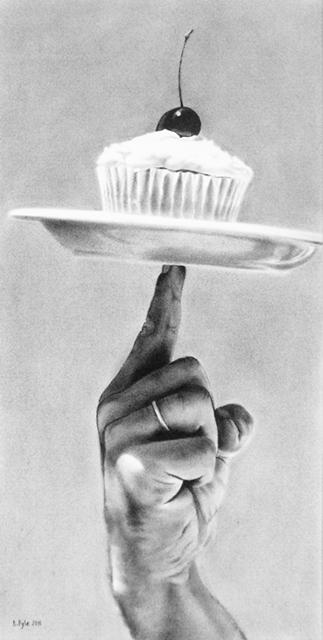
Lark: Let’s start with one of the first place winners – Dan Pyle. Why have you chosen him?
Peter: I’ve chosen him for his skillful precision and his ability to render objects in some sort of space. He renders his objects in a strange way, but not surrealistically strange. From one angle the objects seem very familiar, but Pyle renders them so that they dissociate from their reality.
Lark: I also like the sense of humor that Dan applies to his art works. For example, in Unbalanced Diet. But let’s move to our other First place winner – Erick Pedersen.
Peter: Pedersen’s stylizations are more painterly, although, his characters still have a strong sense of presence to them. He does not individuate his subjects to the point of their being portraits. But they come close to portraiture. They’re more than just models. They hover between model and portrait. Those figures have a mystery about them, about who they are and what is happening to them. Their seeming passivity is misleading. You feel some drama behind it.
Lark: Does Erick’s style help him make all of this happen in his art?
Peter: His method is itself quite stylized. And has influences from fin de siècle central Europe such as Klimt and Kupka.
Lark: Okay. Now about the Second Place winner – Sam Senack. She is more about childlike wonder than the theme of our competition might be.
Peter: Right. I think her subjects, figures or animals play their roles in the story she creates in her assemblages. I like her figures and animal sculptures – they are quite fanciful. But it is her imaginative use of light in the compositions that attracted my attention. And she actually animates her subjects – boots and gloves – with light.
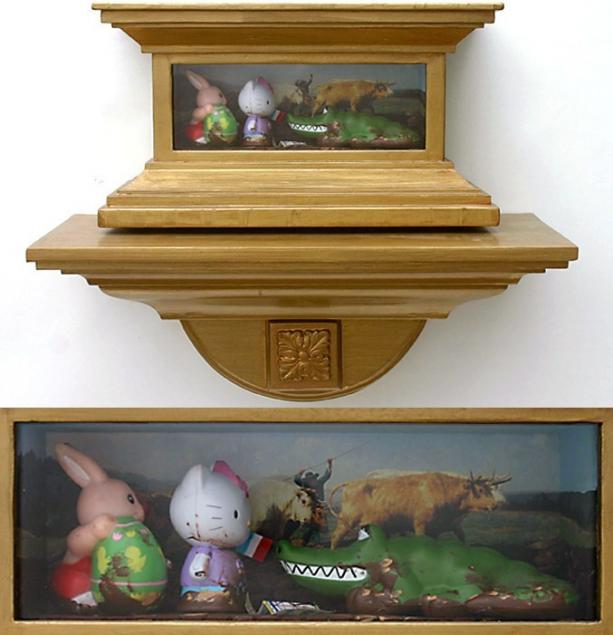
Lark: Let’s proceed to the Third Place winner – Michael Chomick.
Peter: He is an assemblagist. I appreciate his heraldic compositions, which are very amusing – all these little toys and figures placed in architectural constructions in a neo-classical style.
Lark: Is it also his sense of humor that attracted you to his works?
Peter; Yes, although this aspect of his work is secondary for me. I most appreciate his ability to put things together, how he puts all these very different objects into harmonious compositions.

Lark: The next runner-up who was very close to the winners also does assemblages – Paul Baker.
Peter; Although Baker has a different kind of sensibility, but his skills and strengths are similar. He has that ability to find objects and put them together in a surprising and clever way... I should say poetic and clever. He proposes situations that integrate a sense of mystery. For example, he uses a regular dollhouse in different perspectives and in different contexts.
Lark: Next Artist is Kate Barrengos.
Peter: The shared factor between Paul Baker’s art and Kate Barrengos’ is that they both use common materials and objects in mysterious landscapes, which give their artworks a sense of ambiguity. Kate paints children’s toy blocks as constructing famous architectural buildings such as the Greek Pantheon and Frank Lloyd Wright’s Fallingwater. Besides it being a clever idea, it’s well done. It’s lucidly painted and it’s visually rhythmic. She displays a good use of tonality. It’s philosophically interesting because it proposes microcosm and macrocosm. And it proposes an architectural structure in real space as oppose to flat space – the surface of a canvas. That gives her artworks a kind of third dimension.
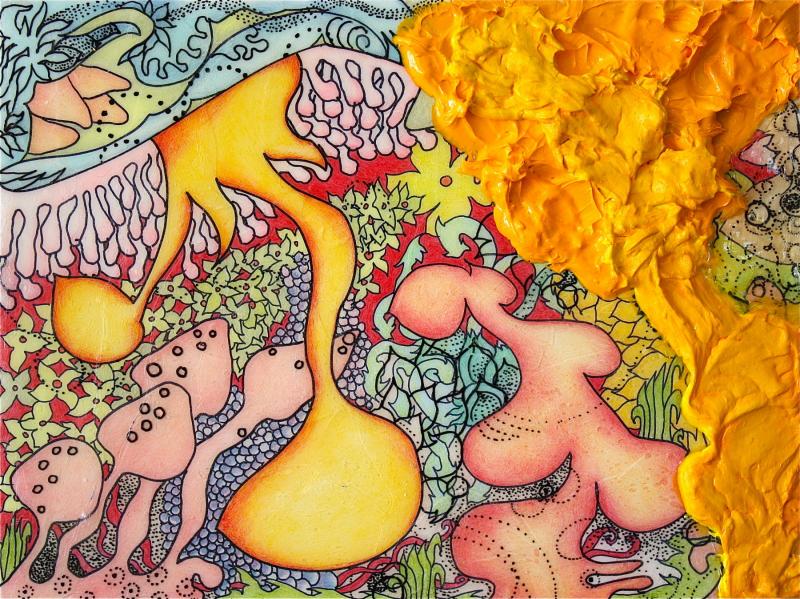
Lark: Let’s talk about Tracy Harnish. What kind of style does her art belong to?
Peter: Her art is psychedelic and it also derives from animation.
Lark: It’s almost on the edge of decorative, but there is something that separates her work from other artists working in this style. It also reminds me a little bit of Gorky.
Peter: To a certain extent. She sets up a narrative and works with it. That creates the sense of ambiguity in space and meaning. She also displays a good application of color and a certain sense of volume, to the point that the two qualities speak to each other.
Lark:Let’s proceed too Roya Adjory. She has different series of works. But jurors judged these, which are, as far as I know, small scale. Does it matter?
Peter: It does not matter. What matters is how she expresses herself. I like her play with subtle tonalities, distinct colors and spaces.
Lark: Does this kind of art also belong to the abstract expressionist style? Would you say that she also uses biological themes?
Peter: Pretty much so. But the biological theme is not as pronounced as in Tracy Harnish’s work. Adjory’s works also have a foggy feel to them, which I like a lot. It’s almost the same colors that Harnish uses, but with a more subtle transition from one tonality to another.
Lark: One artist’s colors are very bright, while the other’s are very subtle. So, what is that that speaks to you? Is it talent?
Peter: It’s what they do with what they have. It’s how they do what they do with what they have. It’s what they choose to have in their work and how they work with it.
Lark: To clarify: Roya could use a bright palette but she chooses to work with foggy colors and does it well.
Peter: Right.
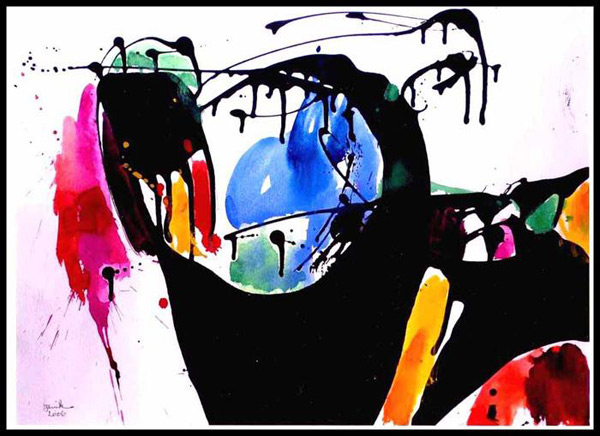
Lark: Let’s proceed to Jenik Cook.
Peter: In her paintings Cook uses active colors, lines and forms, and as a result her compositions do not sit still.
Lark: Jenik is from the Jackson Pollock generation, and as we know he had a lot of followers. What is special about Jenik’s art? What does separate her from others?
Peter: Her compositions are quite distinctive for the way she gets the things in them to move.
Lark: I personally like that some of her abstract works move almost to the figurative…. One more of our Honorable Mentions, Sallie-Anne Swift, seems to belong also to the abstract expressionist style, right?
Peter: Yes, although her compositions tend to be more static. They are harmonious and very well balanced.
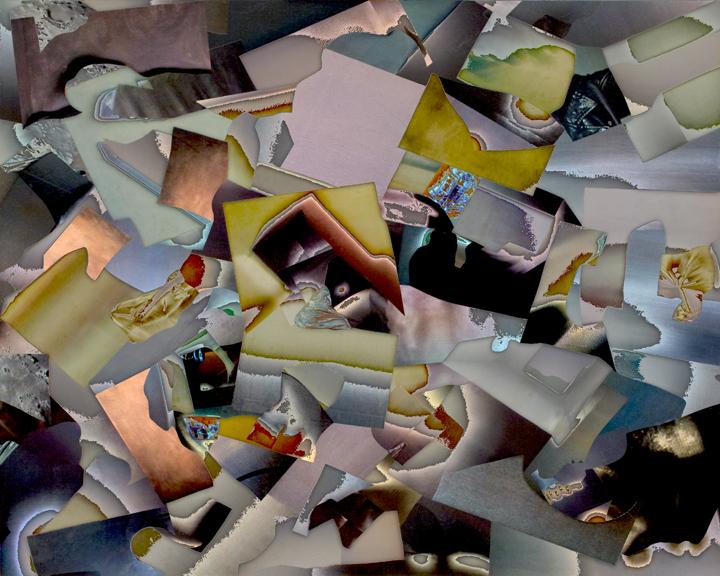
Lark: And the last one in our Honorary Mention list is Marlene Struss.
Peter: She puts colored areas into motion and breaks them up. The viewer has the feeling that something was put on hold. Her colors are pretty settled. This is collage. And the fact that it’s composed digitally, not materially on the paper surface, is significant, not because she uses different techniques, but because such different techniques provide a different angle on surface, edge and color.
Lark: And, again, there lots of digital collagists. What attracts you as a critic to her art?
Peter: In all cases what attracts me is the visual presence. We are not looking at the real thing. So the presence has to jump out of the image.