
LAURENCE VITTES' INTERVIEW
ON "ART OF NOW, MUSIC" WINNERS
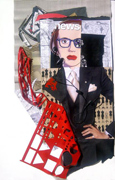
NORMAN SACHS marries his musical art to Georganne Heller's visual accomplice with a wisdom far beyond his frisky years; it's an iconic love song composed of jaunty, lovesick tune and bittersweet poetry. I don't know if the woman in Heller's equally iconic assemblage really barks out commands in such a dominatrix way, but it's fascinating just to think she might be willing if the necessity arose.
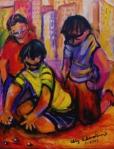
ANDRE SWIFT'S "My Old Yard," profoundly inspired by Abby Rubinstein's endearingly primitive "Marbles," takes a simple ballad genre and builds a narrative that unusually delays the refrain's nostalgic trigger--old, simpler playgrounds from a bygone time--until the images and ambiance have been established, through music and rhyme, of climbing trees, playing pirates, and all those other fondly-remembered activities when "imagination ruled the mind."

YOLANDA KLAPPERT plays music by Frank Martin and Johann Sebastian Bach as if each piece music had been written specifically for the painting she has chosen to pair it with. Each note she strikes responds with a brief, brittle tonal glow that allows it to permeate the surface of the visual experience: In "Ansel's Trees" she highlights the separation and then the movement of the leaves, and eventually even the layers of the sunset; in "Terrces for Moonlight Audiences" she suggests an unsettling but wonderful consciounsess to the foreground's enigmatic, large rounded shapes.

Through her vocal purity and musical focus, YELIANA connects with what might be in the reverie of a beautiful young girl named Katya to the point of actually feeling the emotion when thought perceived as being "hers" connect to something deep inside. After the opening few bars drift surreally, slightly disconcertingly into a more standard intro, Yeliana's voice takes over in its most ethereal, magical register, sweeping the viewer into its vestal arms and bathing the combined musical-visual experience in light.
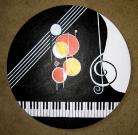
VERA IVANOVA'S delectably titled "Bartokagel," layed out by pianist Mikhail Korzhev with great dramatic architecture on the flat coffee table stage of Debora Gilman's "Piano in Silhouettes and Shadows," matches exquisitely the painting's spare lines and evolving mysteries. While there is no denying the power to entertain of Ivanova's fusion of observational references to Bela Bartok and post-modern futurist Mauricio Kagel, the greatest power of her brief, angular, crystalline music lies in its power to provoke the gods of symmetry.