
News of LA: The Broad Museum Opened
A New Kid on the Block
Media Review by Natalie Fet
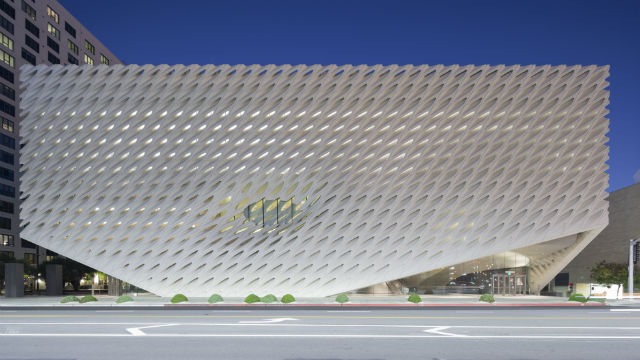
Photo by Iwan Baan, courtesy of The Broad and Diller Scofidio + Renfro
Since September 20th, when the Broad Museum finally opened, Los Angeles has had two museums of contemporary art. With all the hype and pomp surrounding the “most-heralded opening of a private foundation in decades”, tickets to the Broad remain reserved until the end of November, so in this post we limited ourselves to reviewing the press, quoting those of LarkGallery’s represented artists who were lucky enough to get inside the museum, and making some general observations.
The appearance of a new institution in many respects resembles arrival of a new kid on the block. It can be deferential to others or demand control by establishing its own rules. In turn,
old-timers may greet the new-comer, trying to make it feel at home, or give it a cold shoulder. At least in one respect, the Broad had won even before its opening: the Hammer Museum, apparently fearing the competition, had to drop its admission fee and to announce free admission as soon as the public learned that admission to the Broad was going to be free of charge. MOCA, which stands right across the street from the Broad, did not follow suit on the free admission, but made a nice welcoming gesture to the Broad by offering a free one-year membership to anyone who shows a Broad admission ticket during the first two weeks from the latter’s opening.[i] The Broad itself has not made any bows yet, not even architecturally: the building, a three-story box balanced on a smaller base, which, in the museum architect Elizabeth Diller’s own words “fills out its envelope”, seems to be pressing against its neighbors on both sides, pushing them away with its short flanks, as if shouting: “Here I am!”.
The history of the museum’s construction is well-documented in the media. For the most impatient readers, here is The Broad Museum Time-Lapse compressing the four-year-long construction effort into a one and a half minute vignette. Among the considerable press coverage that it has received in the past month, we can have museum’s architectural concept explained, witness museum’s art installation, have a virtual tour of the premises, and get a taste of the grandiose opening festivities that lasted nearly a week (see here, here, and on The Broad Museum page of the Facebook).
Now, to reviews and opinions:
The building, from the outside:
“ Gefilte fish. Tripas. Cheese grater. Packing material. Scratching post. Coral. Except for the last, provided by the building's architect, Diller Scofidio + Renfro, all of these visual allusions suggest that Los Angeles's new Broad Museum—which houses Eli and Edythe Broad's 2,000-piece contemporary art collection—is in stiff competition for the free-association sweepstakes waged by its neighbor, Frank Gehry's Disney Concert Hall. Who can forget the sweeping romanticism of Herbert Muschamp on Gehry's Guggenheim Bilbao (the older brother of Disney): "It's a bird, it's a plane, it's Superman. It's a ship, an artichoke, the miracle of the rose."
Critics searching for what the Broad looks like aren't searching the skies or the waves, but the supermarket aisles. The museum […] is a three-story box clad in porous panels made of white glass-fiber-reinforced-concrete (GRFC). It's not meant to be romantic, organic, or referential […]”. Alexandra Lange, Curbed
“When you see the Broad from a distance, what stands out is a sense of near-total enclosure — the consistent cover of the white facade, which DS+R's Elizabeth Diller refers to as the "veil" covering the "vault" of archive and office space filling most of the second floor.
The skin recalls the 1964 American Cement Building on Wilshire Boulevard, by the L.A. firm DMJM, as well as SANAA's 2007 New Museum in New York and a range of postwar experiments in concrete shade screens by Le Corbusier and other modernist architects.
More to the point, it helps the Broad act as a foil to Disney Hall next door. Where the concert hall is reflective and extroverted, the museum is matte and mute.[…]
A large dimple along the front of the museum, which the architects call an "oculus," marks the location of a second-floor lecture hall overlooking Grand. The rest of the facade is oddly inert and largely opaque, with little of the lightness or translucency suggested by the word "veil." Christopher Hawthorne, LA Times
The building from the inside:
“Once they've [the visitors – NF] found their way into the museum lobby, they'll discover a remarkable, cave-like room, long and narrow, with undulating walls finished in gray Venetian plaster. There is no ticket desk; museum staffers will roam the ground floor on foot, like employees at an Apple store.” Christopher Hawthorne, LA Times
“The space carved out between the three modes of transportation (the escalator and the elevator that take you up, and the stairs that you use to get down, - NF) and their differently-angled holes might be the most interesting place at the Broad: a scudding sky above you, the suggestion of dark eruption below, and buffed concrete floor spreading all around.” Alexandra Lange, Curbed
“An even bigger surprise greets visitors upon entering the museum lobby, whose warping, dancing walls, with their sinuous lines, give the impression that visitors just entered into a dark, mysterious cave.” Edward Goldman, Huffington Post
Clearly: any building that rises next to Frank Gehry’s Disney Hall is going to invite comparison with it. The Broad Museum’s architects and founders (that is, Eli Broad himself), realized it at the very inception of the museum back in 2010, and tried to avoid this competition by conceiving a building which is the total opposite to Gehry’s, so there would be no basis for comparison and the building would “hold its ground through contrast”[ii]. In fact, the division by contrast is applied so consistently, that we can literally make a list of the oppositions that define both buildings:
Disney
The Broad
an organically shaped “sculpture”
a flat box
made of shiny reflective materials, constantly changing their appearance during the day because of the changing light
covered with a matte and porous “shell”, so immutable
that one of the critics had to declare: “the Broad is the perfect Brand Architecture™ for the Instagram age, because it always looks the same, whoever is behind the camera, whatever the filter.”
interacts with the pedestrians
the façade is inert and immobile, except for the oculus that does attempt to “suck you in”
It’s as if the Broad is telling Disney: “I am everything you are not”. Has it avoided the comparison? Hardly: rather, it’s reintroducing it under the different terms. Has the building succeeded on its own? We will have to see. However, it’s already obvious, that there is a part of the Broad that attracts everyone, and it’s not the external appearance, which keeps getting new nicknames (a “net shopping bag”, was recently suggested by one of our represented artists), but the vault. The 70,000 square feet (which is more than a half of the Museum’s overall square footage) organically shaped container partially hanging in the air between the lobby and the 3rd floor open-space gallery, which actually houses a 2000 item collection of artworks, is uniformly spoken about with a softened voice, mysterious overtones and overwhelming reverence:
“The works not on view or on loan are housed in the "vault," a dark-gray concrete structure that shades the lobby under a 45-foot cantilever at its foot, and holds the luminous third-floor column-free gallery on its back. To go from light to dark to light again, you must travel through the belly of this beast, either by slanting, suggestive escalator or circular, machined glass elevator. To miss either ride would be a shame. The Hobbit-y design language of the vault reads as an honest and surprising idiosyncrasy, a weird innovation that I wonder if DS+R will ever repeat outside this scenographic setting.” Alexandra Lange, Curbed
Perhaps, the vault is where the real intrigue of the building lies: the shrouded vault contains a treasure, that the visitors are about to discover. The moment of discovery is cleverly postponed and never fully arrives. The visitors’ route becomes a journey from outside inward with a constant interplay of their changing perceptions. From the very first steps into the lobby, they watch the vault’s outer “cavernous, sinuous lines” which put “one into a particularly adventurous mood”, and hope to quickly get to the treasure by taking an escalator that pierces the rolling surfaces of the ceiling. After landing on the third floor – in the exhibition space – museumgoers are presented with a well-lit exposition, but feel teased even more because only a tiny fraction (currently 250 works) of the 2,000-piece collection is displayed, and the visitors are still outside the vault. And only on the way back, from the landings of the stairways which are the only way down and back to the lobby, they can see some glimpses of the storage facility containing the whole treasure that eluded them all this time, and is, perhaps, an enticement to come again.
Thus, the main attraction, the start and the end point of the journey is the Broad’s collection after all. What do the critics have to say about it? The most scathing pronouncement comes from the Wall Street Journal:
“There’s nothing personal about the Broad collection. It offers no original, independent art insights—you learn nothing from seeing these artists here that you wouldn’t at MoMA or the Whitney. Nor is there a trace of any wayward, individual sensibility. It’s a strictly mainstream, Usual Suspects collection, the perfect mirror of the status quo. The Broad collection isn’t about taste but net worth—sheer buying power and the ability to amass an outsize portfolio.” Eric Gibson, Wall Street Journal.
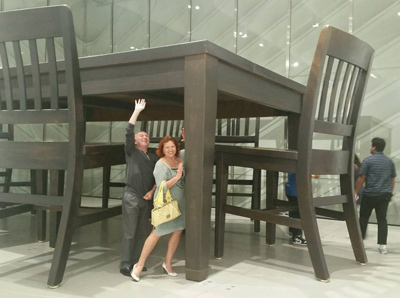
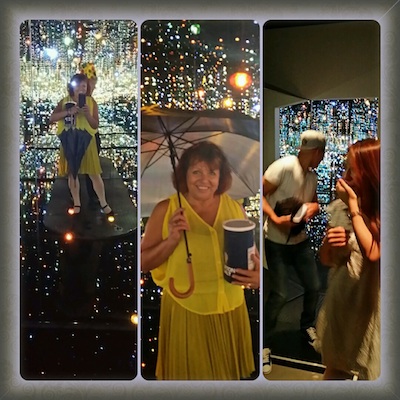
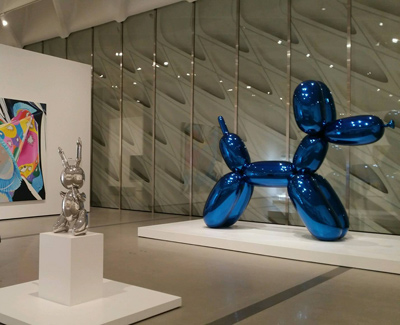
Perhaps, this opinion is a little too harsh. After all, the Broads’ collection of Cy Twombly, Jean-Michel Basquiat, and Roi Lichtenshtein are famous for its depth. In the inaugural exhibition, the artists represented are Robert Rauschenberg, Jasper Johns, and Andy Warhol from the ‘60s, Chuck Close, Bernd and Hilla Becher, and Joseph Beuys from the ‘70s. The artists of the ‘80s and ‘90s include Keith Haring, Jean-Michel Basquiat, John Baldessari, Cindy Sherman, Barbara Kruger, Jeff Wall, Andreas Gursky, Jeff Koons, Damien Hirst and Kara Walker. The art of the new millennium is represented by John Currin, nine large screens videos by Icelandic artist Ragnar Kjartansson and a mirrored installation by Yayoi Kusama titled ‘Infinity Mirrored Room: The Souls of Millions of Light Years Away’. If you like these artists, you should go and see their works exhibited.
Still, the problem discussed in the Wall Street Journal article quoted above is a real one, and one that is very close to my heart as it has to do with collecting. The Broad’s collection does not discover new names. “There’s no artist or movement here that hasn’t already had abundant exposure in museums and galleries over the years, if not the decades.” That means that Eli Broad is not interested in rewriting art history, rather he invests in an existing one, turning his art objects into just another form of investment. Perhaps, this is what Shana Nys Dambrot meant when she posted “I think what bothers the art world most about the Broad is that it's not really for the art world.”[iii].
Having said that, I am planning to go to the Broad as soon as the crowds die out, and invite you to do the same. My favorite route to walk to and from the museum would not be the wide and noisy Grand, but the small street between Grand and Olive that runs between the two buildings of the Colburn School of Music, then between MOCA and the Omni Hotel down to the Water Court at California Plaza. It has everything that Grand has and more: good architecture combined with quietness, benches and the cutest fountains, shady trees, several cafes and the sculptures of Nancy Rubin – what else can one possibly need? And, if you do it on October 24th, you’ll witness the GRAND AVE ARTS day when eleven theaters, museums, and musical collectives, including the Broad Museum, Center Theatre Group, Colburn School, Grand Park, LA Opera, Los Angeles Central Library, Los Angeles Master Chorale, Los Angeles Philharmonic, MOCA, The Music Center and REDCAT will open their doors and perform for the public down on the Grand Avenue. That would be something to enjoy!
[i] “The Broad Museum Is Newest Addition to South Grand Arts Culture”, by Alana Bracken, https://medium.com/annenberg-media/the-broad-museum-will-be-newest-addition-to-south-grand-arts-culture-562736710acc
[ii] “Eli Broad’s Museum Is Latest Bid to Transform Downtown Los Angeles” byJori Finkel, New York Times, Sep 9, 2015, http://www.nytimes.com/2015/09/10/arts/design/eli-broad-hopes-his-museum-helps-an-arts-district-grow.html
[iii] Shana Nys Dambrot’s September 22, 2015 post on FaceBook.
Photos by Iwan Baan, courtesy of The Broad and Diller Scofidio + Renfro, and by Galina Kovshilovsky, courtesy of the author.