
PETER FRANK'S ARTICLE AND COMMENTS
ON FIND YOUR ROOTS COMPETITION WINNERS AND HONORARY MENTIONS
FIND YOUR ROOTS
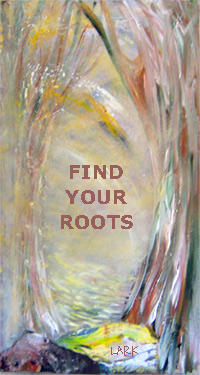
Roots? What do artists know or care about roots? Aren’t they all searching for a universal language? Aren’t they trying to escape or transcend that which ties them to specific places, people, and things? They are, to be sure, but most of them recognize, despite their aspirations, that as human beings they come from somewhere, they embody something distinct, and they carry within them seeds of their specific cultures. Indeed, if we could define what the role of the artist is, we might say it is to plant the seeds of his or her culture in the soil of other civilizations – and thereby plant the notion of universal vision in every region of the world. It starts with roots, it ends with roots, in between it is art.
By “roots” do we mean the way artists derive nourishment from their environment(s)? Do we mean the derivation of their DNA? Do we mean the source of their art – how they started to make art, or what feeds into the art they make now? Of course, all the above. The themes of competitions – art competitions, at any rate – are ultimately defined by the competitors.
In a sense, all art is a search for roots. Art is certainly a search for connection, connection to audience and connection to source. And roots constitute a particular kind of connection and a very particular kind of source. But when artists are instructed to "find their roots," they can go off -- according to their various sensibilities and attitudes -- in many directions. They can look for the roots that anchor plants to the ground and they can look for roots that anchor humans to geography. They can look for roots to families and peoples and they can look for roots to histories and experiences. Artists can find roots in the earth, roots in the ocean, roots in the pavement, and roots in the sky. So can we all, with a little stretch of our imaginations; but artists are the ones who remind us of these shared abilities and guide us in imagining and realizing such processes of finding.
The directive "Find your roots," with its implied exclamation point, may sound like a command. But artists take commands and turn them into suggestions, opportunities for improvisation and adventure. Calling up an army of artists is like herding cats; but that's why it's worth doing. Every cat will wander on its own path, and every artist -- every artist, that is, who has arrived at that particular point of evolution from which there is no turning back, that point at which the artistic mind has taken over -- will not simply answer to the call, but will reshape the call according to conjured structures unanticipated, unimagined by the callers, even if the callers themselves are artists.
You can’t go home again, as American author Thomas Wolfe noted. In the artists’ case, they don’t have to go home again. They carry around their home(s) like turtles: they are always at home in art. But where did that home, art or otherwise, come from? Where did the artist start? Of what is the turtle shell made of? The participants in this competition have tried to respond to these questions, knowing they can only contribute to an ever-incomplete answer.
Peter Frank
Los Angeles
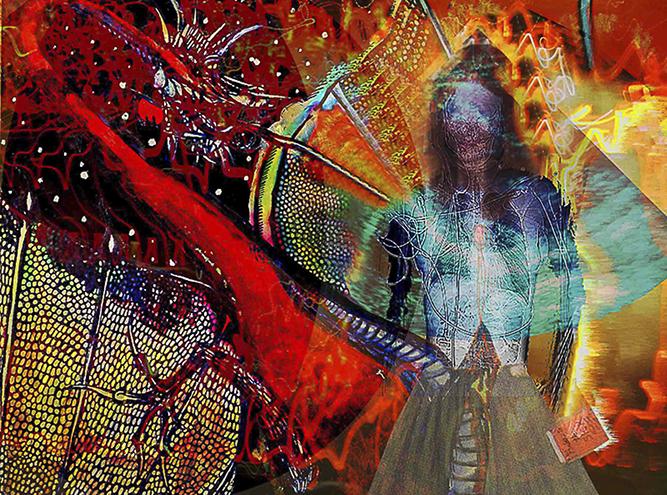
MELISSA ANN LAMBERT - 1st Place
These digital photo collages have a remarkable atmospheric, almost viscous depth to them, establishing viscerally felt spaces in which unlikely elements encounter one another.
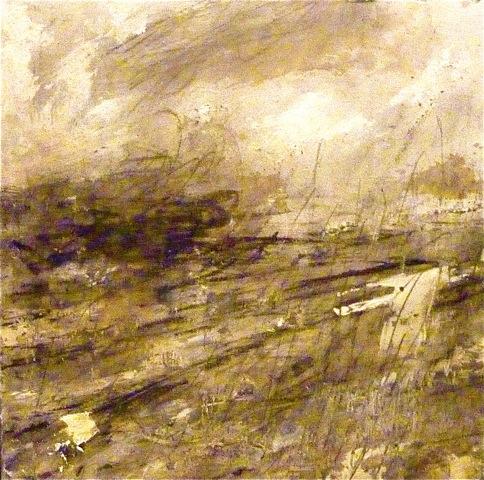
SERGEI TIVETSKY - 2nd Place
The inscription of scumbled lines on canvas results not just in the accumulation of marks, but for once in convincingly nostalgic landscape space.
YOUNG SUMMERS - 3rd Palce
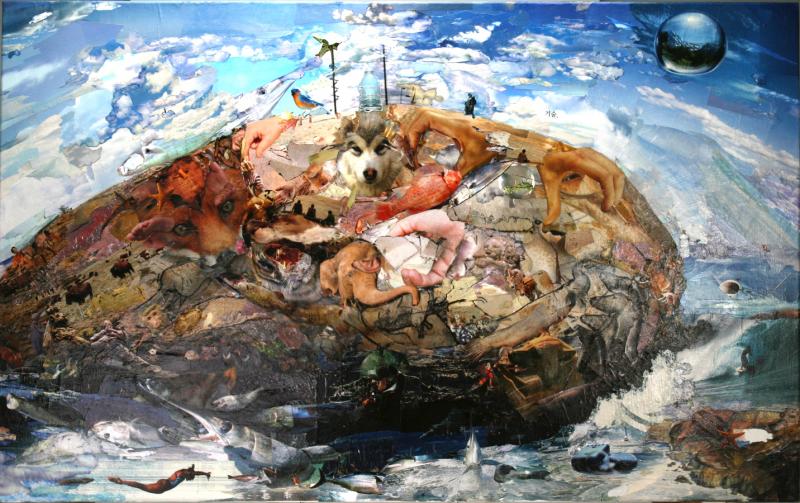
Collage elements don't normally provide painterly brio, but these images benefit from a graceful touch and controlled but still energetic texture.
ERNA AVON -- Balances between color and pattern, touch and structure
SUZANNE BELCHER -- Strong, almost architectural sense of composition makes photomontage elements cohere
ELIZE -- Exuberant color and strong organization help convey a lively wit
ERIK FISCHER -- The clarity and simplicity of black-and-white photography are put at the service of an inferred narrative
GREGORY HICKS -- Rhythmic compositions and clear, strong forms make for dynamic imagery
J. NATASHA KOSTAN -- Elegant application of the "collage aesthetic"
LUCA KRSTICH -- Humor supported by a keen knowledge of the modernist vocabulary
LINDA KUNIK -- The object is aestheticized at the same time as the artwork is objectified
TERESA LAKIER -- Vibrant color underscores the high energy of eccentric minimalist forms
ARMINEH TEMOURIAN -- The drama of infinite yet inflamed spaces
FRANK WHIPPLE -- For all their dynamism, these fantasies of mechanization look back to a pre-digital age