
PETER FRANK'S INTERVIEW
ON ART OF NOW WINNERS
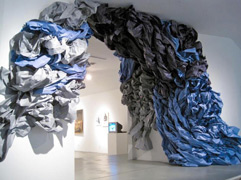
OLGA LAH builds her installations out of discarded items,
clearly commenting on our waste, our use of non-biodegradable objects,
and other ecological issues. What makes her work distinctive, even new-seeming,
is its color sense, its humor (seemingly lighthearted but with a grimness underneath),
its rhythmic use of repeated units, and its expansive sense of space.
Lah’s installations engulf us like waves – waves in a sea of detritus.
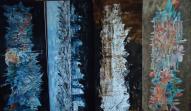
MOKO KHACHATRYAN employs an elegant line to achieve a rough texture.
She fills her fields with myriad marks, organizing them into almost organic clusters.
They take on the density of brambles or tree branches. It is a kind of traditional approach to abstraction, but its grace and sensuality seem new, or at least renewed, for an ungraceful, unsensual age.
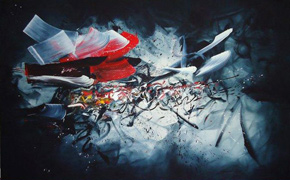
VAHAN RUMELYAN revives the calligraphic gesturality of Georges Mathieu,
and equally of Kiki and other painters prominent in the Bunker Group.
Rumelyan adds a new element to his predecessors’ vigorous linear expression,
a peculiar sense of depth. Many of Rumelyan’s lines seem to incise the very surface
upon which they are inscribed, defining a shallow but optically defined space “behind” the picture plane.
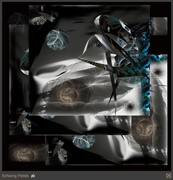
MELISSA LAMBERT gives a new, unusual complexity to the digital photocollage,
including an aqueous depth and obscured detail that forces the viewer
to oscillate between the overall composition, essentially abstract, and the referential details
of the imagery. At the same time, Lambert’s compositions, orbital and heraldic, set up a whole
different framework for “reading” her pictures.
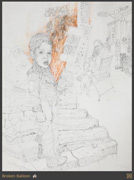
JODI BONASSI may be best known for her upbeat, rough hewn depictions
of barber shops and other sites of public interaction, but here she offers tender,
detailed, and slightly strange drawings of children and other domestic figures.
What she brings to this time-honored practice is a sense of anxious, almost paranoid distortion.
Such expressionism doesn’t usually pervade renditions this exacting, this naturalistic.
Bonassi has brought to the present day the “anxious realism” of the Weimar-era New Objectivity.