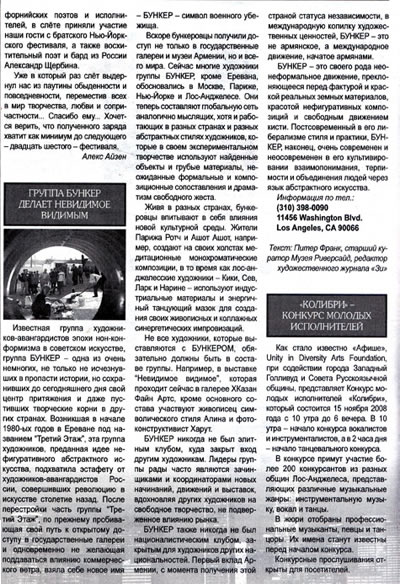
THE BUNKER GROUP: MAKING THE INVISIBLE VISIBLE
By Peter Frank
Art Show In H.Kazan Gallery
One of the notable avant garde artists’ collaboratives from the Non-Conformist era of Soviet art, the Bunker group is one of the very few not to have faded into history – and to have spread to other countries. Coalescing in Yerevan, capital of Armenia, as the Third Floor Group in the early 1980s, the artist team, devoted to non-objectivity as forceful as that produced in Russia a century ago, could be said to have made its way downstairs, from the obscure upper reaches (the “third floor”) of the exhibition space to its equally hidden cellar; but from the bunker, the artists can access the street more easily.
The Bunker artists have accessed not only the street, but the world. Even before the fall of the Soviet Union, Bunker artists were emigrating, internally – to Moscow and Leningrad – and externally – to Paris, New York, and Los Angeles. They now constitute a global network of like-minded, if very different, artists, all working off a fluid concept of abstraction that embraces expansive composition, coarse materials, unexpected formal juxtapositions, and a dramatic sense of gesture. They respond to their new-found cultural environments; Paris-based painters such as Rotch and Achot Achot create chromatic meditations in patterned structures, for example, while Los Angeles-based artists such as Kiki, Sev, Lark and Narine conjure industrial transmutation and painterly gesture.
Not all artists who show with Bunker are in the group; abstract symbolist painter Alina and photo-constructionist Harout Kazan currently share wallspace with Narine, Kiki, Lark and Sev at Kazan’s West Los Angeles gallery. Bunker has never been an exclusive club, only a way of coordinating and presenting an artistic state of mind. And it has never been the expression of a people – it is not an Armenian movement, but a universal movement begun by Armenians, the country’s first contribution to the international art scene since gaining independence. It is a kind of neo-informel movement, enamored of texture and material but equally enamored of image and movement. Post-modern in its catholicity of style and practice, Bunker, finally, is very modern – and neo-modern – in its cultivation of community.
This article was also published
in the Russian Magazine "Afisha" ("Russian Billboard").
If you can read Russian, please, click on the image to enlarge it.